Monday, July 12, 2010

Tongli, Suzhou

I have met up with The Cal Poly group that is doing a Summer Study Abroad Program in China. Irma Ramirez is the the Professor leading the interdisciplinary group of architecture, urban planning, and landscape architecture students. It is nice to see some familiar Faces!


I have arranged to stay with them for the next Several days and piggyback on their discussions, insight and experiences. Our first activity was to explore the "water town" of Tongli. The large area of Central Eastern China is mostly lowlands in and around the delta outlet of the Yangtze River. Tongli is one of many of the water towns that contain well preserved Chinese architecture and gardens.


It's very interesting to me how much of traditional Chinese design it based on symbolism and/or a direct reference to Chinese mythology and culture. Gardens and buildings work in reciprocal means and are guided on two different systems, yet integrate seamlessly. Their is a constant search for Balance.

After Tongli, we traveled to Suzhou , which was the center for art and culture during the Ming Dynasty ( 15th-16th century). It is a walled in city, surrounded by a mote, with a collection of site and gardens. Our first stop, was at the Suzhou Museum, designed by Chinese American architect IM Pei. The Museum is meant to recognize the town of Suzhou for its historical and cultural significance and contributions to China. The building itself is an elegantly modern interpretations of traditional Chinese design. It contains all the same core elements but in contemporary fashion.

Suzhou also contained some gorgeous traditional Chinese gardens, such as the Humble Administrators Garden and Lions Grove. In these Gardens, Water plays an essential role. If anything, it is to balance the atmosphere, but of coarse water provides this element of life and serenity.


On this trip I feel Like have taken in so much and I'm only about halfway through. I am already looking forward to future design projects where I can put these ideas to use.

Guangzhou, China

After crossing China's Border over land from Hong Kong I stayed in China's southern Largest City Guangzhou. Historically known as Canton, locals people speak Cantonese, a dialect of Chinese distinct from Mandarin.


I wanted to make a stop in this area because Southern China Coast is China's most industrious region, and the city of Guangzhou is growing rapidly. The town itself seems to be one large construction zone , I never thought I would see brand new high rise buildings completed on roads that had even been paved yet. Though hard to maneuver, there are several standout projects underway that I wanted to visit.

one is a Skyscraper named the "Pearl River Tower." this design by SOM was published to be the worlds first "Carbon neutral Skyscraper", that is, it would produce more energy than it would consume thus offsetting carbon emissions. This would be achieved by shaping the facade of the building to force prevailing winds into concentrated locations, passing through turbines to power the building. The design also employs geothermal heat sinks,waterless urinals, integrated photovoltaic and daylight responsive controls. Unfortunately the building is planned for completion in October, and I did not see this energy marvel in action.

Another project that has just finished, though not yet open, is the Guangzhou Opera house designed by London based Zaha Hadid. This space age post modern building creates interesting spacial experiences and contrast the vertical buildings that surround it. But when up close to the building, the trained eye can quickly establish this building was "made in China." I would imagine that this is due to the general lack of vital communication between the designer and the builder, for various reasons.


China Is Massive and complex. It rightfully makes up the biggest chunk of my itinerary, and there is Much more to see.

Hong Kong

My first impression of Hong Kong is WOW! TO sit in awe at the skyline surrounding Victoria Harbor , one cannot help but to impressed with what mankind has accomplished. And in Hong Kong, it has truly been an international collaboration to build this metropolis.


With a Population of over 7 million and an average density of more than 6,000 people per square kilometer it is one of the most densely populated places in the world. And amazingly, unlike most great cities of the world, Hong Kong developed almost entirely with out any political will. The cities development was driven solely by commerce, and as a result, it is jam packed with unpredictable nuances that only a free market enterprise would allow for.


Rather than large formal open spaces found in many political capitals, the public domain of hong Kong lies in its vast network of inter modal transit, retail and pedestrian corridors. There are seemingly three street levels with in central hong kong: A sub-terrian level, open air ground level ( with auto traffic) and a "plaza level" (raised above the ground that directly connects the central atrium's of all the high rises). All three levels seamlessly connect with flowing pedestrian traffic.


Right now Hong Kong's relationship with China (since the 1997 relinquishment by the Brits) is "one nation - Two systems " . Before 97' Hong Kong had an open door policy to immigration (mostly Chinese ), which in combination with booming commerce led to such high densities.There are some parts of the city that could be considered the "best example of globalization in progress". For the most part, HK has dealt with these densities with High Rise apartment blocks, much like the "towers in the park" scheme of Le' corbusier. Whatever your aesthetic opinion maybe, in this case they seem to be quite successful at full filing their function


I was able to go to Hong Kong University and see the Thesis exhibits of the masters of architecture program . I always enjoy seeing what peers are working on and what they produce. Daisy Yiu , Cal Poly arch. class of '09, now lives in hong Kong and was kind enough to show me parts of hong kong most foreigners don't get to see. It has been fun traveling during the world cup, getting to see each city in an excited social form.


Many internationally renowned firms hold ans office in hong Kong, SOM, OMA and Foster and Partners to name a few. All have built works in the city as well. Hong Kong is by any definition a modern Mega city and could be considered a capital of a global society if there is such a thing. I found a quote by Foster about Hong Kong.. " Hong Kong might be the most interesting place I've ever been. I never Thought I would be in a city that made New York look like a Sunday Afternoon. "

Tuesday, June 29, 2010

Bangkok, Thailand


OH the many faces of Bangkok! This bustling city is full of character and culture. With a population of 7.7 million people , it is considered to be the capital of not only Thailand , but all of south east Asia. And I must say, it has left a lasting impression on me.


Like many cities of the east, It has experienced rapid growth in recent decades and contains a vibrant mix of new and old, traditional and contemporary. The "Sky Train" has a massive presence in the urban space of Suhkumvit Street, while the grand palace is iconic of traditional Thai style.


Water has played a huge part in Thai culture. Bangkok was built on the river outlet of the Chao Phraya River and the city developed as a main trading hub. At one time, Bangkok was called the "Venice of the east" with Thai people considered to be "amphibious" but with modernization, streets paved over canals and the water front boundaries became more defined.

The use of informal Urban space by the Thai people was quite striking. What can appear to be a back ally turns into a busy night market. Vendors pull up there carts to create ad-hock markets on the side walk, in the metro terminal and in the streets. Side walks and streets can have very different personalities at different times of day.


I visited the Chulalongkorn University, Department of Architecture which is located in the center of Bangkok. It is the only Architecture program in Thailand conducted in English. Fortunately, they were having an open house when I arrived and was able to meet students and faculty and discuss their work.


Not Far from the university is the Bangkok Art and Culture center which is free to the public, and is more of a public forum for artist then it is a museum.

Jim Thompson's House is unique attraction. Jim Thompson was an American who Revived the silk trade in Thailand after wold war 2. He studied architecture at Princeton, worked in new york, and changed careers for a life in Asia. He built a Large house in Traditional Thai Style in the 1950's that is impeccably detailed.

Bangkok recently was on the world stage for all the wrong reasons. The city is incredibly lively and the people very friendly. They say, " You can never get bored in Bangkok"


Wednesday, June 23, 2010

Angkor, Cambodia


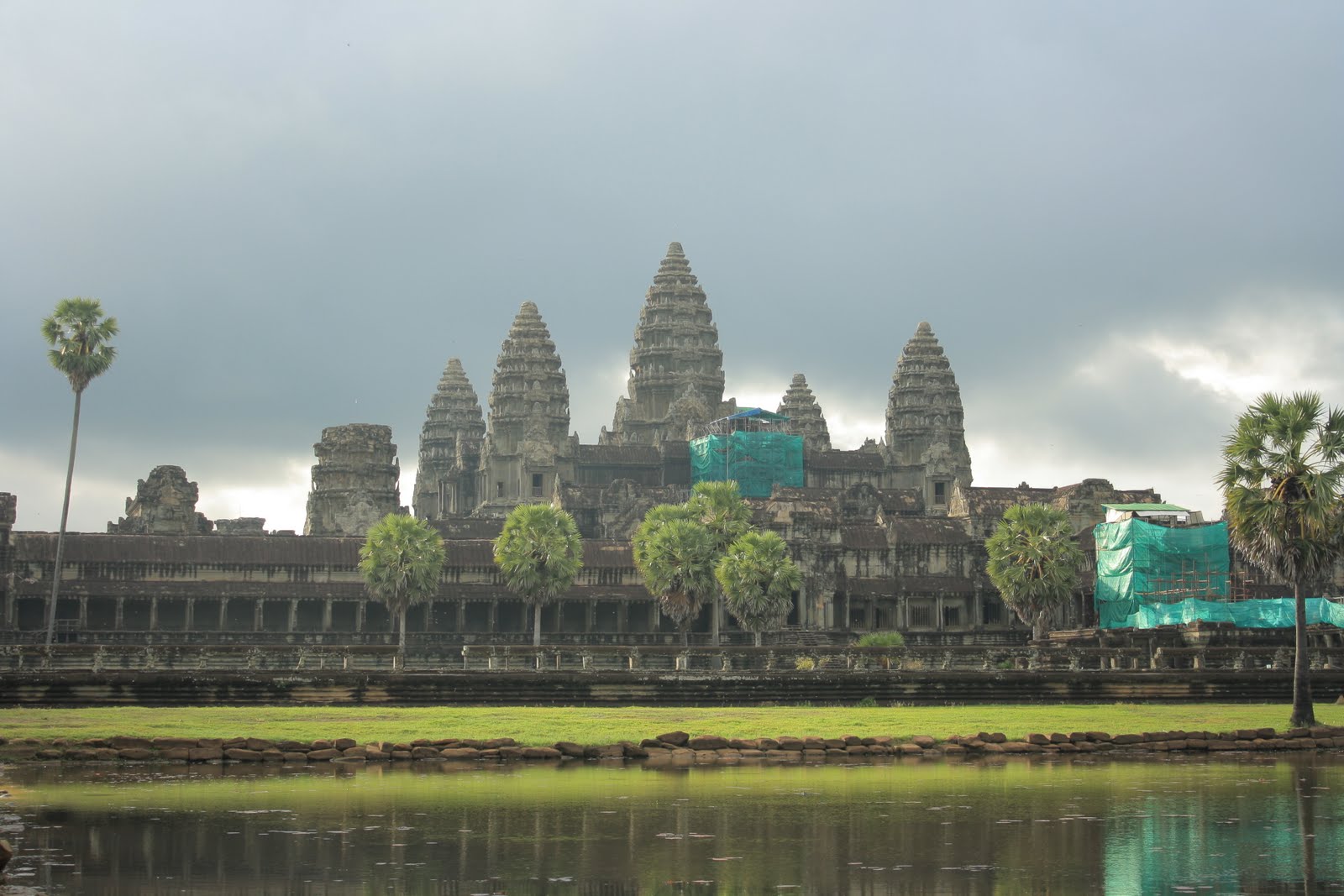
For the last three days I have been trekking through and exploring the amazing collection of archeological sites at Angkor, Cambodia. Angkor is the ancient capital of the Khmer empire which was the leading civilization in South East Asia from 9th century to 13th century AD. The collection of temples and monuments collectively occupy an area of over 77 square kilometers.


This Location in Cambodia was chosen for its fertile lands and proximity to a large inland lake. Khmers used aqua duct irrigation in combination with a number of water reserves in and around the temples which manifested themselves in the form of motes and reflection pools.


The most iconic form of the architecture is the “mountain temple.” The mythology and ideals of Hinduism inspire these vaulted pyramid forms which are meant to be symbolic of Mt. Meru. Symmetry and axial views inform the planning of these temples and complexes, with concentric courtyards adding layers of progression.


Each structure is lavishly adorned with different deities depicting the cosmology and folklore of Hindu culture. And while the flamboyant details are unique to the culture, time and place, I can also draw similarities seen in the architecture of other civilizations pre dating the Khmer Empire.


The Order, repetition and symmetry of these temple cities seem to draw upon architecture form Mesopotamia – as if high civilization moved east as well as west. Because in fact, the Khmer Empire is was an expansion of civilizations from India. I find myself trying to make these connections, attempting to piece together the facts to reveal how the world architecture came to be.


These temples and ruins provide an almost surreal setting where nature has continued to grow long after the inhabitants of these ancient structures have gone. Cambodians still regard the sites as religious institutions and treat the greater Angkor area as a national park.


The world Heritage sites of Angkor are profound my any means. They provide and in depth look at an ancient society that shaped the culture of a region.


Thursday, June 17, 2010

Khao Lak, Thailand

I am now 2 hours north of Phuket, in the coastal town of Khao Lak. Before I left the states, I became pen pals with a Surf shop owner over here. He also runs surf lessons and rents bungalows right on the beach. To get to the site, it is a Two mile off road car trek through an elephant sanctuary.


Right now is the off season for tourism, but the best time of year to surf. Even then, the surf in Thailand is so-so compared to other places around the world, but to the locals, it’s all you need.


I am the only “non thai” person staying in the Bungalows as of right now. Ching, the owner, has friends staying over and they help to maintain the place and make improvements before tourist season. They are also in the middle of switching surf shop locations. So after some discussion over a surf session – Ching and I came to terms. I could help him out with some things around the camp and at the shop and he would knock some off my rent.


So I painted this wall mural in the new surf shop. Yes, it was my idea. But everybody likes it. So far, Thailand is pretty cool : )

Wednesday, June 16, 2010

Phuket, Thailand

My first stay in Southern Thailand is on the island of Phuket. Phuket is the largest island in Thailand, and bost some of the world best beaches. The main industry here is tourism, and being such, I cant seem to walk far with out a local taxi driving chirping “ Hey were you go? You need Taxi?”


This personal transportation option is not the best option. First off, the vehicle is a moped. NO helmet, nothing. Just jump on the back and go. Plus, they ask for way too much money. The Mini-bus however ( a pick up truck converted to have a cover and benches in the back) is cheap, fun and naturally air conditioned.


The beaches are beautiful. Words cannot do it justice. If you have seen the Movie “the Beach,” starring Leonardo Dicaprio, it was filmed on a nearby smaller island. The landscape is truly surreal.

This is the lagoon from "the Beach." The island's actuall name is Phi Phi (pronounced PEE - PEE )

This leg of the trip was full well planned to be unlike any other part. Were most of the time I will be in cities, high desnsity and full on compleling architecture, My southern Thailand experience was meant to be one of culture. I am going to try to relaxing and examine the lifestyle of the Thai people outside the city.